I am proud to announce that my daughter passed off the humdinger, the final rite of passage into the 36 club. The humdinger is 36 addition cards + 36 subtraction cards + 36 multiplication cards + 36 division cards mixed together and completed in 5 minutes or less. Humdinger doesn't even begin to describe it. You have about 2 seconds per card. There isn't time to get stuck on one problem. Every problem must be memorized. There isn't anything I can do to help kids pass them off at school, but there are things parents can do to help their kids pass it off at school.
Many students decide they can't do it before they try. One little girl came out in the hall today and told me she wasn't ready to do the humdinger. She wouldn't even try. It sounds intimidating but most students can do it if they work on it at home with a parent on a daily basis. Here are some tips to help your child on the road to success.
1. Work on individual sets until your student has their time down to 1:15 per set before you mix the cards together. (This is 15 seconds less time than they had when passing off the individual sets. Mean. I know.) Make sure they know they can already do all the problems in 5 minutes. They just have to learn how to do it when they're all mixed up. (The cards, not the student.) Once they are combined, don't expect a great time. They have to train their brain to take in all those signs and numbers and spout off another number in less than two seconds. It takes time. If they get stuck, remind them if their adding, subtracting, multiplying, or dividing.
2. They have to go through the entire deck every day. I noticed if my daughter missed a few days she would add a lot of time to her score. It was frustrating for us both. The repetition also helps them get over their nerves when they do it in school.
3. Don't do it more than once a day. With the individual sets I didn't let them stop until they beat their previous time. There were days when we worked on cards for half an hour. But I've noticed the humdinger tends to fry little brains. They do it only once no matter their time.
4. Keep track of their time and if your child's time is not improving:
A. As you go through the cards with your child make two piles. One for the cards they know as soon as they see them and a second pile for the ones that take them longer than two seconds. Go through the second deck with your child until they can do all the cards in less than two seconds. Keep the hardest problems toward the front so they know they can get them over with. For some reason my daughter hates this method but she can't argue with the results.
B. Slowly move the cards toward your child as they figure out the problem. This is similar to the previous method but they can actually see their time melting away. My daughter hates this method even more than the previous method. I think she improved her time just so I wouldn't do it to her anymore.
5. Make sure they get a chance to pass their 36 club stuff off at school. Volunteer. My kids didn't pass off their math until I volunteered in their class. I'm the only parent that does 36 club for both my elementary school aged children. In previous years the parent volunteers never got to my children because we are toward the end of the alphabet. They never got through the entire list and always started at the top. I usually mark the student where I left off. I don't get to my own kids every time. I wonder how many classes don't get any volunteers at all. It makes me sad. I've seen other students improve significantly as I've worked with them individually. There is nothing more rewarding than seeing the light in their eyes when they finally get it.
6. Bribery. My daughter really loves gum. I really hate it. So as an incentive I offered to get her a pack of gum when she passed off the humdinger. It worked. She has her gum. (And she'd better not get it in her hair.)
For help on individual sets click the links below
Addition
Subtraction
Multiplication
Division
Comments are nice. I really like them. Comments help me to know that I'm not just writing this for myself.
I'm thinking of doing a post on helping kids learn to read. Anyone out there interested?
Showing posts with label 36 club. Show all posts
Showing posts with label 36 club. Show all posts
Thursday, May 24, 2012
the dreaded humdinger


Monday, March 5, 2012
36 club Division Tips

Make up a variety of questions for them based on number of guests and how many pieces each guest should get. For example. If we have a family of 4, plus grandma and grandpa, plus six friends. How many pieces should we cut the cake into? What if everyone wanted 2 pieces?
Small candies and cookies are also fun to use for teaching division.
Once the child understands what division is, you can move on to the cards. They should have their multiplication facts down before you teach them division. This is especially helpful since division is multiplying backwards.
Start with the twos. Explain that to divide by two, you are just cutting the number in half. They can also use the same tricks they used when they learned multiplication.

It gets a little tricky when they get to six. This is where knowing their multiplication comes in handy. When they get stuck on a division problem I turn it into a multiplication problem. If they draw a blank at 42 divided by 6, I'll ask what times 6 is 42? If they are still stuck, I'll ask what 6X5 is. (30) I ask if they should go higher or lower. (higher) What is 6X6? (36), 6X7? (42.) Then they have their answer. It can take time for them to learn division. Be patient and they'll get it.
Use whatever tips they liked for multiplication with division. (Be sure to read my tips on multiplication. The link is below.) For example: My son remembers 7 and 7 went to heaven to see the 49ers. With dividing I'll say: 7 and who went to heaven to see the 49ers? Then he'll yell seven. Eventually they remember it on their own. Same with 8X7=56. (5,6,7,8) When we see 56 divided by 7 I'll point to the numbers and count out loud to remind him of the tip. Then I'll ask what's missing.
This next tip is my favorite.


If they accuse you of leading them astray when they hit 21 divided by 3, ask them if 2 and 1 make 9. It has to fill both criteria. They can turn this around too. If they have 63 divided by 9 then the answer is one more than 6.
So there you have it. I hope this makes sense. Leave a comment if it doesn't. Every child can learn these facts!
Humdinger tips
Saturday, December 3, 2011
36 club Multiplication Facts
It's been a while since I started posting tips for the 36 club. I've been working with my youngest on multiplication so I thought I'd post on the subject while it's fresh in my mind.
Since multiplication is more complicated than adding, it's important to make sure they understand the concept behind it. A fun way to teach this is to bake cookies.

Show the child you have four rows and three columns.

They have four sets of three cookies or

three sets of four cookies. I like to call 3 X 4 the cookie problem.
Once they understand the concept, start with the twos. (I'm not posting ones, tens, or zeros because they're easy to explain.) They already know their addition facts. Explain that when they are multiplying by two they are adding doubles. So 6 X 2 is the same as 6 + 6.
Next you have the threes. This is where skip counting comes in. They should already know how to count by 2's and 5's. When teaching skip counting, put the numbers to a song. Try the melody to Twinkle Twinkle Little star for 3's and Row Row Row Your Boat for the 4's. Once they have the songs down, show them how to count off with their fingers.

Kids can learn to multiply 5s by skip counting, but eventually, they need to speed things up. All they half to do is cut the number is half. So, for 6 X 5. Half of 6 is 3. Put a zero on the end. That's the answer. For odd numbers, it doesn't half evenly, so they will have a 5 at the end instead of zero. So, for 5 X 7, half of 7 is 3.5. 5 X 7 is 35.
My kids have a hard time remembering the skip counting for 6,7, and 8 so I went for a different approach. But first I'll skip to 9. I think most people know this but I'm posting it anyway just in case. Have the child hold up their hands when they are multiplying a number by 9. Count the number of fingers they are multiplying nine by and put that finger down. My example below is for multiplying by six. The answer to the problem is in the number of fingers left up.
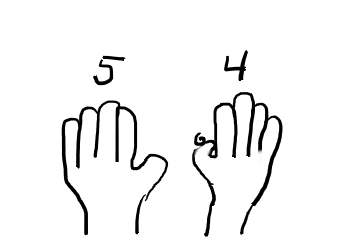
This leaves us with higher numbers. 6X6, 6X7, 6X8, 7X7, 7X8, and 8X8
For 6X6 and 6X8, have the child count by fives first. This goes back to adding sets of numbers. So first they have to figure out how many 5 sets of 6 equals. Then they just have to add one more set. So five sets of six is 30. Then they add one more set of six for 36. It also helps to point out that even numbers multiplied by six end in that number so when they say the complete fact out loud it rhymes.
My daughter learned a poem for 7 X 7: Seven and seven went to heaven to see the 49ers.
I added to it to help with 6 X 7.: 6 lost a shoe and only got 42. (No it doesn't make sense. But the rhyming helps anyway.)
My son insisted I come up with one for 8 X 8: Eight and eight slipped on the floor. How many stiches? 64.
The last one is the easiest. 7 X 8. They're in order. 7 - 8. The answer is in order too. 5 - 6. So it counts. 56 =7*8 (5,6,7,8)
One more tip for multiplying even numbers. If they get stuck when multiplying any even number, all they have to do is cut the number in half, multiply, and then double the answer. For example: 8X4. You could cut either number in half. Half of 8 is 4. 4X4 is 16. 16 +16 is 32. (8x4=32) Or you could cut the 4 in half. 8X2 is 16. 16 +16 = 32. (I can't do that math problem without the inchworm song getting stuck in my head. Click the link. You know you want to.) My son has a hard time remembering 6X7, despite my genius poem. Now he cuts 6 in half (3), multiplies that by 7 (21) then doubles the answer. (42)
And that covers all 36 facts. It is important to practice the facts with the kids every day. I time them and let them stop as soon as they beat their old time. After a while they start remembering them without all the tricks. My son's multiplication time is 4.5 min. We've been working on these for about a month. I still have to remind him of the tips while we go through the cards but he remembers most of them on his own.
*Update. It's been a few years since I first posted this blog. My son is now in 3rd grade and his multiplication time is down to 1:41. (So close!) His second grade teacher didn't do 36 club so he got rusty. We're still learning as we go so I added tips on cutting numbers in half.
Addition Tips
Subtraction Tips
Division Tips
Humdinger tips
Thursday, September 15, 2011
36 Club Subtraction tips

This only works when the top number in the tens column is less than the bottom number in the tens column like this.
18
- 9
A lot of kids freak at this because they don't have eighteen fingers. So I tell them to subtract upside down. Take 8 from 9 and get 1. If the upside down answer is 1 then the answer to the problem is 9.
16
- 8
If the upside down answer is 2, then the answer is 8. (3 - 7 and 4 - 6.)
Go back to 18 - 9. If 18 were one more (19) then the answer to the problem would be 10. But 18 is one less than 19 so the answer is one less than 10. Notice the pairs always add up to ten.
This works because if the top number is 2 away from giving you the answer of 10, then the answer is 2 from 10 or 8.
If your child doesn't understand the upside down terminology, try the 1 from ten or 2 from ten. They can use this method for more complicated math, just don't let them forget that they still have to borrow!
I'd love to know if this helps anyone.
Addition Facts Here
Multiplication Facts
Division tips
Humdinger tips
Thursday, September 8, 2011
36 club addition tips

My kids elementary school have a program called the 36 club. They have to pass off 36 facts in 1.5 min or less in addition, subtraction, multiplication, and division. Then they mix all the facts they've passed off into one massive pile called the Humdinger. They get five min to pass it off. It's an amazing program. You would not believe how fast some of these kids can rattle off their math facts.
I love seeing how the kids answer the questions. Some drawl out the answers like they are bored out of their minds. Some dance on their chair and spit out the answers when it comes to them. Some jump from their chair and point to the cards as they yell the answer. I love seeing their excitement when they pass off their facts. And it breaks my heart when they are sooo close. I can tell when they are stuck on the upper numbers so I give them hints. I thought I'd share those hints so other people can help their little ones learn their math facts.
1- Close to double. Most kids get their doubles right away. My kid's teachers have drilled doubles into their heads starting with 1st grade. They don't have a choice but to memorize them. 7+6 is almost a double. They already know that 6+6=12. So remind them that 7 is only one more than 6. Once they understand this concept, they won't panic when they see 6+8. Instead they can remember that 6+6=12 and then count up from there.
2- Nines. We all know that 5+10 =15. So 5+9 is one less than that. I tell the kids when they are adding something to nine the answer is one-less-than-teen. So one-less-than five is four. Fourteen. Once they understand this concept, they can apply it to 8 and 7. 8 is two-less-than-teen and 7 is three less-than-teen. My kids sometimes do 6 too.
3-Take out the ones they get stuck on. When I have some extra time and I can see the student always gets stuck on the same two or three problems, I'll pull the cards out of the deck and go over them separately. There is usually a reason why they hit a brain cramp on specific problems. Focusing on the problem cards will usually help them sort it out in their heads. Then I put the hard cards first so they can get them over with. It also helps to inform them that they will never forget the problem again. Somehow this solidifies the problem in their minds whether they want it to or not.
If I've been less than clear, please let me know and I'll try to reword it or draw pictures. When I explain these methods to the kids I can tell when they get it based on the look on their face. I'll do other posts on the rest of the math sets later. I guarantee a method to make sure your kids will never forget the answer to 7x8.
Subtraction tips
Multiplication Facts
Division tips
Humdinger tips
Subscribe to:
Posts (Atom)